Fundraiser from Kildare walks 300km for prevention prior to risk-reducing mastectomy
After discovering she carried the ATM gene mutation to deciding on risk-reducing breast surgery, 48-year-old Sinead Harmey adopted a lifestyle focused on prevention through diet, regular screening and exercise.

- Written by Breast Cancer UK
- Posted: 1 November 2025
- 5 min read
Sinead is now based in London, although she is from Kildare, Ireland. She and her sister were always aware of their mother's breast cancer history.
"She had breast cancer when she was 57 and then again at 73," says Sinead. "When she got it the second time, I was living in Ohio, in the States, because I'd gone there in 2012 to do my PhD. Initially, the doctors tested me only for the BRCA 1 and 2 genes, but my sister, who is a scientist, was tested using a broader multigene panel and tested positive for the ATM gene mutation. I was subsequently tested with that panel and tested positive too. That was 10 years ago. "
While her sister opted for surgery, Sinead chose to focus on lifestyle changes.
"For me, the advice was losing some weight, eating well – all the kind of stuff that BCUK advocates for, plus additional screenings."
The following decade after her diagnosis saw Sinead change her lifestyle, along with regular screenings, including MRIs and other tests. In August 2017 she moved to London, where she is an Associate Professor in Literacy Education and Director of the International Literacy Centre in the Department of Learning and Leadership at UCL Institute of Education.
Weighing up the risks
Then, in January 2025, everything changed. Sinead got a letter from the genetic service at St George's Hospital, London, suggesting it was time to re-evaluate her risk. She thought it would be a basic five-year review, but it turned out to be more involved.
"There's now more research and understanding of the ATM gene and its variants, which meant that my risk had increased," she says. "Combining that knowledge with my family's history was significant, as there are cancers on both sides of the family; my dad passed away with bile duct cancer. That's what risk is. It's the sum of all parts. I got a letter a month later that I was eligible for risk-reducing surgery."
It was not the result Sinead had expected when she went for the review. She decided to step back and consider her options.
"I spent the first three or four months of the year trying to figure out what felt right for me," she explains.
"I read the resources on the BCUK website, talked to the genetic services, went to see a breast surgeon and oncologist privately. You hear a lot of different things and need to filter and sift and know what's right for you.
"Doctors don't tell you what to do, so I had to weigh 'what if' scenarios", she continues. I went through a process of how I would feel if I got breast cancer and I knew I had this option now. And then how would I feel if I didn't get breast cancer, but I had the surgery, would I then regret having the surgery? How would I feel about having the scars? You really can only make that kind of decision that on your own."
She adds that there are so many people involved in the process – including the genetic counsellors, the breast surgeons, the plastic surgeons, the Macmillan Counselling Psychologist– and they all offer a different slant. She also notes a lack of dedicated ATM gene support groups, although she found some US-based online communities.
Living in the moment
After months of research, Sinead decided the risk-reducing surgery was her best option. She was then on a pathway of plastic surgeons, breast surgeons and psychologists to make sure she understood the consequences of her decision.
"I'm quite happy with the decision to do it. I have a lot of support – my husband is great, along with the rest of my family, and friends are invaluable, too. There was a time when I didn't want to have those heavy conversations with everyone, and I had some very close friends who I would talk to."
She has completed her pre-ops and is currently on the NHS waiting list.
"Waiting is hard, but it isn't as emotionally stressful as making the decision," she says. "But it helps you to be more present because you can't plan far ahead. Even going or not going back to Ireland for Christmas. People might ask me to do things in November or in the Spring, and I tell them I don't know if I can commit to it. I've seen everyone I'm supposed to see at the hospital, and I'm just waiting until there's a place for me."
Walking in all weathers
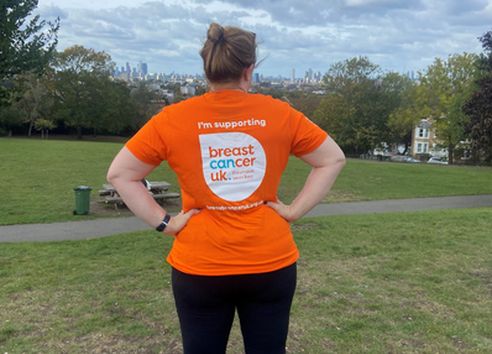
October is Sinead's birth month, and she decided to celebrate how walking has been beneficial to her mental health by committing to walking 300 km to raise money for BCUK.
"Walking helps me reflect and manage stress," she explains. "I throw my headphones on and it's just headspace. Sometimes when I'm walking, I leave people long voice notes, listen to a podcast, or walk quietly. After all, it was while walking in the west of Ireland on a break with my mum that I finally made the decision."
"I like BCUK's ethos of movement and empowerment to reduce the risk and walking has been my saviour, so I think it's a good focus."
According to Breast Cancer UK, Being active can reduce your risk of breast cancer by around 20%. It’s thought that physical activity lowers the level of certain circulating hormones and reduces inflammation, which can lower the likelihood of breast cancer developing and progressing. Being active also keeps your weight under control, significantly lowering the risk for both women who have reached menopause and men. The NHS and World Health Organisation suggest at least 150 minutes of moderate exercise per week, but the more you do, the better.
Sinead's walks average 10km a day and range from a daily routine in London to visits to Ireland. In the past, she walked four days on the Camino de Santiago trail in Spain and would like to do that again.
"It sounds a lot, but it's amazing how little tweaks add up your steps," she says. "For example, I work in London, so I get off the tube at Tottenham Court Road and walk to Bloomsbury and back."
Sinead continues walking even in poor weather, quoting her personal trainer, who reminds her that humans are waterproof. After surgery, she expects to scale back physical activity temporarily – another reason she's built walking into her current fitness routine.
Her fundraising has already reached almost £1,500, and she's rounding off the month with a university seminar with cakes, as a fitting conclusion to a tremendous fundraising effort.
If Sinead’s story has inspired you, simply click here to find out how you can get involved in your own fundraising effort for Breast Cancer UK, or contact the team here to get started.