Vitamin D and breast cancer.
What is the link?

Do low levels of vitamin D increase my risk of breast cancer?
Many studies have found that women with low levels of vitamin D in their blood may have a higher risk of developing breast cancer compared with women who have adequate levels. Vitamin D is mainly produced when our skin is exposed to sunlight, and some studies have found that greater sunlight exposure is associated with lower breast cancer incidence.
However, evidence is mixed, as some large studies have found no clear relationship between vitamin D levels and breast cancer risk. This means that scientists still can’t say for certain whether low vitamin D directly increases breast cancer risk, or whether other health and lifestyle factors might explain the link.
Tips for maintaining healthy levels of vitamin D.
Spend time outdoors.
Get some sunlight on your skin each day, being careful to avoid sunburn.
Get your vitamin D from food.
Eat foods rich in vitamin D, like egg yolks, oily fish and sun-exposed mushrooms.
Vitamin D supplements.
Consider taking vitamin D supplements if you don’t get a lot of sunlight, e.g. during winter.
Key facts about vitamin D and breast cancer.
- Many studies indicate that women who have low vitamin D levels may have an increased risk of developing breast cancer.
- Having low levels of vitamin D is relatively common among women diagnosed with breast cancer.
- To date, Vitamin D supplements have not been shown to prevent breast cancer.
- Vitamin D may help reduce breast cancer risk through supporting the immune system and controlling cell growth.
- Safe sunlight exposure, diet and supplementation are all ways to boost vitamin D levels.
How might vitamin D reduce breast cancer risk?
Studies suggest that vitamin D may help control cell growth, reduce inflammation, promote the death of damaged cells, and limit the formation of blood vessels that help tumours grow.
Should I take vitamin D supplements to reduce my risk of developing breast cancer?
There is no strong evidence that taking vitamin D supplements reduces the risk of breast cancer. Several large clinical trials studying vitamin D supplementation found no significant reduction in breast cancer incidence. For this reason, vitamin D supplements are not currently recommended as a strategy to reduce breast cancer risk.
However, not all scientists agree and are calling for more rigorous, well-designed studies to understand whether vitamin D supplements might reduce risk.
In either case, maintaining healthy vitamin D levels remains important for overall health, and supplements may be recommended for individuals with low vitamin D levels, particularly during autumn and winter months when there is less sunlight.
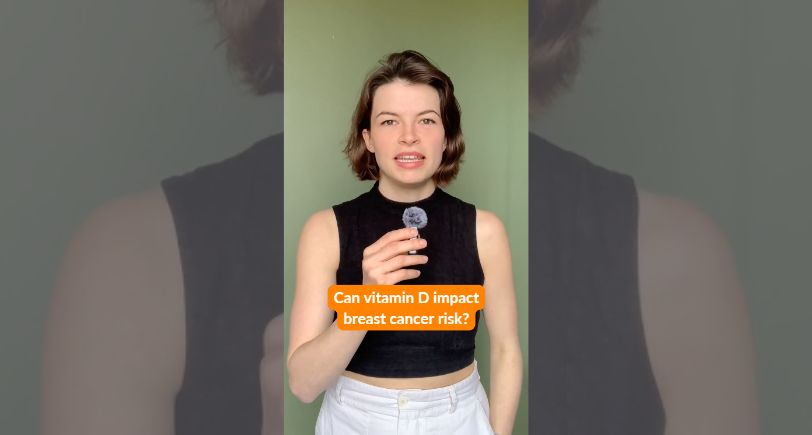
Ask the scientist: What's the link between Vitamin D and breast cancer risk?
What is vitamin D and why is it important?
Vitamin D is an essential nutrient that plays a key role in maintaining healthy bones, teeth and muscles by helping the body absorb calcium. It also supports the normal functioning of both the immune and nervous systems, and helps to control how cells grow and develop.
Where does vitamin D come from?
Unlike most vitamins, vitamin D can be made naturally by the body when skin is exposed to sunlight. Having low levels of vitamin D is common in countries that have limited sunlight during winter months, including the UK. Smaller amounts can also be obtained from food.
How can I maintain healthy vitamin D levels?
Most people can support healthy vitamin D levels through a combination of safe sunlight exposure and vitamin-D-rich foods.

Naturally occurring vitamin D content of selected foods.
Good dietary sources of vitamin D include:
- Oily fish such as salmon, sardines and mackerel
- Eggs (egg yolks in particular)
- Fortified breakfast cereals
- Fortified dairy products and plant-based alternatives (e.g. soy milk or oat milk)
- Mushrooms (Top tip: You can significantly increase the vitamin D content of mushrooms by leaving them in sunlight for 15 minutes before cooking!)
However, it’s difficult to get all the vitamin D that you need from diet alone. Spending short periods outdoors in sunlight allows the body make vitamin D naturally, especially in spring and summer.
Supplementation can help and is recommended for those who are more likely to have low vitamin D levels, including older adults, people with darker skin tones, and people who spend little time outdoors.
How much sunlight do I need to get enough vitamin D?
The amount of sunlight needed varies depending on factors such as skin tone, age, season and location.
In the winter, public health guidance recommends that people of all skin tones take vitamin D supplements between October and March, when UK sunlight levels are too low for the body to produce enough vitamin D naturally. People who cover most of their skin may want to consider year-round supplementation to maintain healthy vitamin D levels. Though it’s not yet known whether vitamin D supplements reduce breast cancer risk, taking them over winter is still recommended to maintain healthy levels and support your overall health.
In the UK spring and summer, studies show that people with lighter skin may get enough vitamin D from as little as 9 minutes of sunlight per day (assuming the arms and lower legs are exposed), while people with darker skin may need around 25 minutes per day. These figures are based on unprotected skin (without sunscreen) being exposed to peak sunlight (between noon and 2pm) every day during British summertime.

Should I take any precautions when out in the sunlight?
According to experts, vitamin D is made most easily during the peak hours of the day (11am-3pm), but prolonged sun exposure during this period should be avoided. In terms of sun safety, it’s best to aim for short bursts of just a few minutes of sun exposure at a time. People with pale skin need to take extra care to avoid sunburn; be careful that skin never turns pink (this is a sign of sunburn, which indicates cell damage).
Make sure you use adequate UV protection on your skin when heading out for longer periods; it’s recommended that people use sun protection anytime the UV index is at level 3 or above (you can find UV index information in your weather app!). Check out the NHS website for more tips and advice on being safe in the sun.
Further reading
For more information, read our Diet and Breast Cancer science review.
Last review: August-26 | Next review: August-29.
-
{1} Mokbel K, Mokbel K. Chemoprevention of Breast Cancer With Vitamins and Micronutrients: A Concise Review. In Vivo (Brooklyn) 2019;33:983. https://doi.org/10.21873/INVIVO.11568
{2} Hossain S, Beydoun MA, Beydoun HA, Chen X, Zonderman AB, Wood RJ. Vitamin D and breast cancer: A systematic review and meta-analysis of observational studies. Clin Nutr ESPEN 2019;30:170. https://doi.org/10.1016/J.CLNESP.2018.12.085
{3} Seraphin G, Rieger S, Hewison M, Capobianco E, Lisse TS. The impact of vitamin D on cancer: A mini review. J Steroid Biochem Mol Biol 2023;231:106308. https://doi.org/10.1016/J.JSBMB.2023.106308
{4} Hiller TWR, O’Sullivan DE, Brenner DR, Peters CE, King WD. Solar Ultraviolet Radiation and Breast Cancer Risk: A Systematic Review and Meta-Analysis. Environ Health Perspect 2020;128. https://doi.org/10.1289/EHP4861
{5} Li Y, Ma L. Exposure to solar ultraviolet radiation and breast cancer risk. Medicine 2020;99:e23105. https://doi.org/10.1097/MD.0000000000023105
{6} Visvanathan K, Mondul AM, Zeleniuch-Jacquotte A, Wang M, Gail MH, Yaun SS, et al. Circulating vitamin D and breast cancer risk: an international pooling project of 17 cohorts. Eur J Epidemiol 2023;38:11–29. https://doi.org/10.1007/S10654-022-00921-1
{7} NHS. Vitamin D https://www.nhs.uk/conditions/vitamins-and-minerals/vitamin-d/ (accessed June 8, 2026)
{8} British Nutrition Foundation. Vital vitamin D! https://www.nutrition.org.uk/media/gyceqobk/vital-vitamin-d_may-2022.pdf (accessed June 8, 2026)
{9} British Dietetic Association. Vitamin D https://www.bda.uk.com/resource/vitamin-d.html (accessed June 8, 2026)
{10} Zemlin C, Altmayer L, Stuhlert C, Schleicher JT, Wörmann C, Lang M, et al. Prevalence and Relevance of Vitamin D Deficiency in Newly Diagnosed Breast Cancer Patients: A Pilot Study. Nutrients 2023, Vol 15, Page 1450 2023;15:1450. https://doi.org/10.3390/NU15061450
{11} Manson JE, Cook NR, Lee I-M, Christen W, Bassuk SS, Mora S, et al. Vitamin D Supplements and Prevention of Cancer and Cardiovascular Disease. New England Journal of Medicine 2019;380:33–44. https://doi.org/10.1056/NEJMOA1809944
{12} Li Z, Wu L, Zhang J, Huang X, Thabane L, Li G. Effect of Vitamin D Supplementation on Risk of Breast Cancer: A Systematic Review and Meta-Analysis of Randomized Controlled Trials. Front Nutr 2021;8:655727. https://doi.org/10.3389/FNUT.2021.655727
{13} Linowiecka K, Wolnicka-Głubisz A, Brożyna AA. Vitamin D endocrine system in breast cancer. Acta Biochim Pol 2021;68:489–97. https://doi.org/10.18388/ABP.2020_5961
{14} de La Puente-Yagüe M, Cuadrado-Cenzual MA, Ciudad-Cabañas MJ, Hernández-Cabria M, Collado-Yurrita L. Vitamin D: And its role in breast cancer. Kaohsiung J Med Sci 2018;34:423–7. https://doi.org/10.1016/J.KJMS.2018.03.004
{15} Abdollahi S, Vahdat M, Saeedirad Z, Mahmoudi Z, Torkaman M, Abbassi Mobarakeh K, et al. Multifaceted Role of Vitamin D in Breast Cancer: A Systematic Review of Genetic and Pathway-Based Mechanisms. Asian Pacific Journal of Cancer Prevention 2024;25:3349–61. https://doi.org/10.31557/APJCP.2024.25.10.3349
{16} Wimalawansa SJ. Vitamin D’s Impact on Cancer Incidence and Mortality: A Systematic Review. Nutrients 2025;17:2333. https://doi.org/10.3390/nu17142333
{17} Umar M, Sastry KS, Chouchane AI. Role of Vitamin D Beyond the Skeletal Function: A Review of the Molecular and Clinical Studies. Int J Mol Sci 2018;19:1618. https://doi.org/10.3390/ijms19061618
{18} Cancer Research UK. Sun and vitamin D https://www.cancerresearchuk.org/about-cancer/causes-of-cancer/sun-uv-and-cancer/sun-and-vitamin-d (accessed June 18, 2026)
{19} Webb A, Kazantzidis A, Kift R, Farrar M, Wilkinson J, Rhodes L. Meeting Vitamin D Requirements in White Caucasians at UK Latitudes: Providing a Choice. Nutrients 2018;10:497. https://doi.org/10.3390/nu10040497
{21} Webb A, Kazantzidis A, Kift R, Farrar M, Wilkinson J, Rhodes L. Colour Counts: Sunlight and Skin Type as Drivers of Vitamin D Deficiency at UK Latitudes. Nutrients 2018;10:457. https://doi.org/10.3390/nu10040457
{22} BBC, Claudia Posada. How much sunshine do we really need? 2026. https://www.bbc.co.uk/future/article/20260807-how-much-sunshine-do-we-really-need (accessed August 12, 2026)
{23} Cancer Research UK. The UV index and sunburn risk 2020. https://www.cancerresearchuk.org/about-cancer/causes-of-cancer/sun-uv-and-cancer/the-uv-index-and-sunburn-risk (accessed August 12, 2026)
